
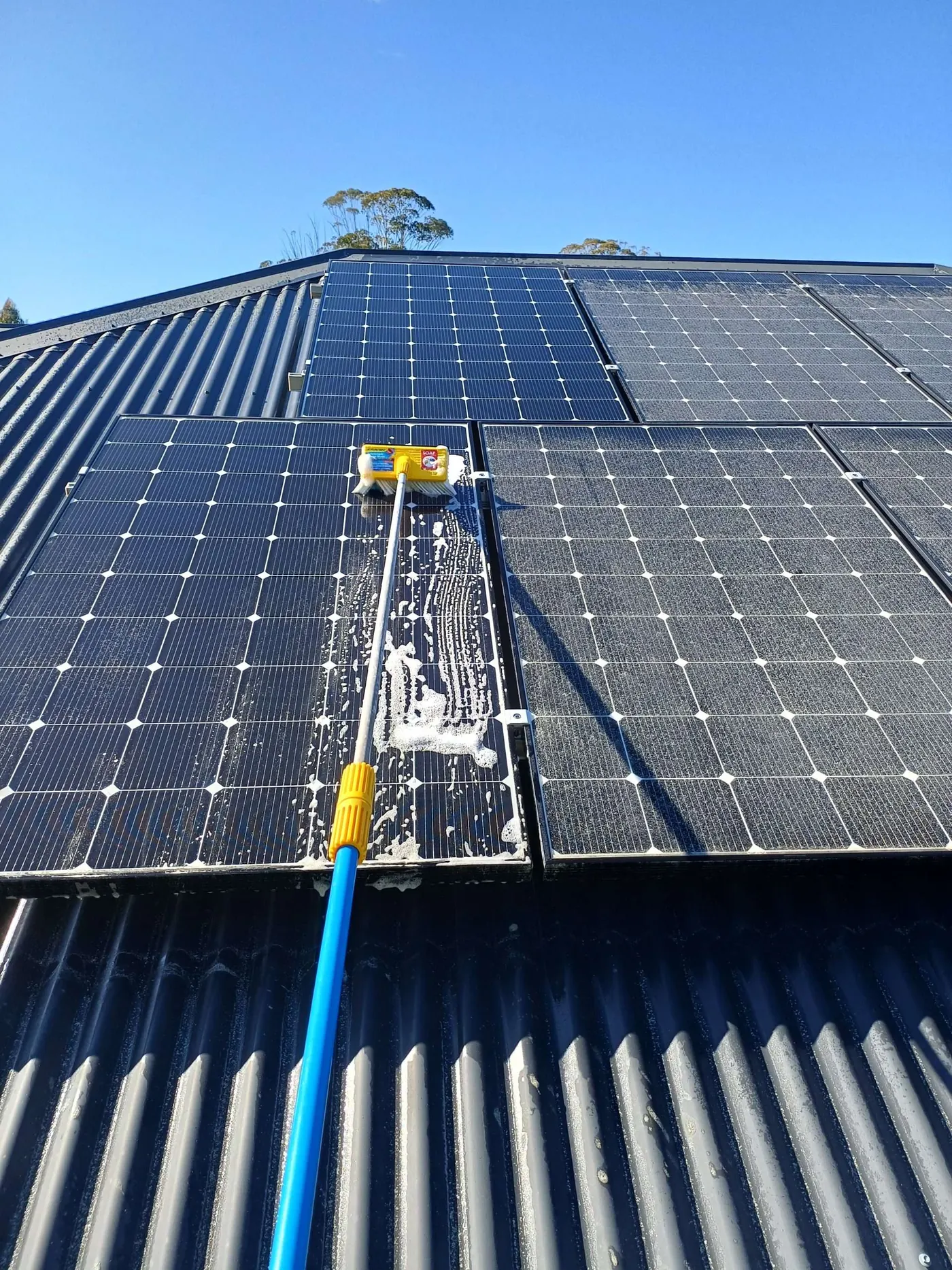
Tap water carries dissolved calcium and magnesium. When it dries on a warm panel those minerals stay behind as spotting and haze, which keeps shading the cells after the dirt has gone. Filtering the minerals out first means the water dries off completely clean, with nothing left on the glass.
Most advice about cleaning solar panels focuses on getting the dirt off. The harder problem is what you leave behind.
What is actually in your tap water
Tap water is not just water. It carries dissolved minerals, mainly calcium and magnesium, picked up on the way to your house. You cannot see them while the water is wet.
You see them when it dries. The water evaporates off a warm panel and the minerals stay exactly where they were, as spotting, streaking and a faint overall haze. That is the white marks on a window after rain, and it is the same thing happening on your roof.
Why that undoes the clean
The whole point of cleaning panels is that anything on the glass is shade, and shade is lost generation. So if you remove a layer of dust and replace it with a layer of mineral deposit, you have not gained much.
Worse, mineral deposits bond to the glass in a way dust does not. Dust blows off. Hard water marks build up over repeated washes and get progressively harder to shift.
Why soap makes it worse, not better
The instinct is to reach for detergent. Don’t.
- Washing-up liquid and car wash soaps leave a microscopically tacky film on the glass
- That film holds dust, so the panels soil again faster than if you had left them alone
- The runoff goes onto your garden and into the stormwater
You also cannot rinse it off properly with the thing that caused the original problem, which is tap water.
What professionals use instead
Pure water. Run the water through a filter that strips the dissolved minerals out first, and it dries off the glass leaving nothing behind. No squeegee, no drying, no residue.
There is a second benefit that matters more for panels than for windows. With no minerals and no detergent in the mix, there is nothing abrasive or chemical touching the anti-reflective coating that high efficiency panels rely on. It is water and a soft brush.
This is what I use. My kit is a PureWash system, designed and made in New Zealand, which is a long reach pole fed through a filter. The pole matters too, because it keeps my weight off the array and off a wet roof.
If you are doing it yourself
Fair enough, and some single storey houses make it straightforward. Three things worth knowing:
- Never spray cold water on hot panels. Early morning or an overcast day.
- Skip the detergent entirely. Plain water and a soft brush beats soapy water.
- The ladder is the real risk, not the cleaning. Wet glass on a pitched roof is where this goes wrong.
If any of that sounds like more of a Saturday than you fancy, solar panel cleaning is a quick job and I will tell you honestly afterwards whether yours needed doing.
Worth reading next: does cleaning solar panels actually make a difference?