
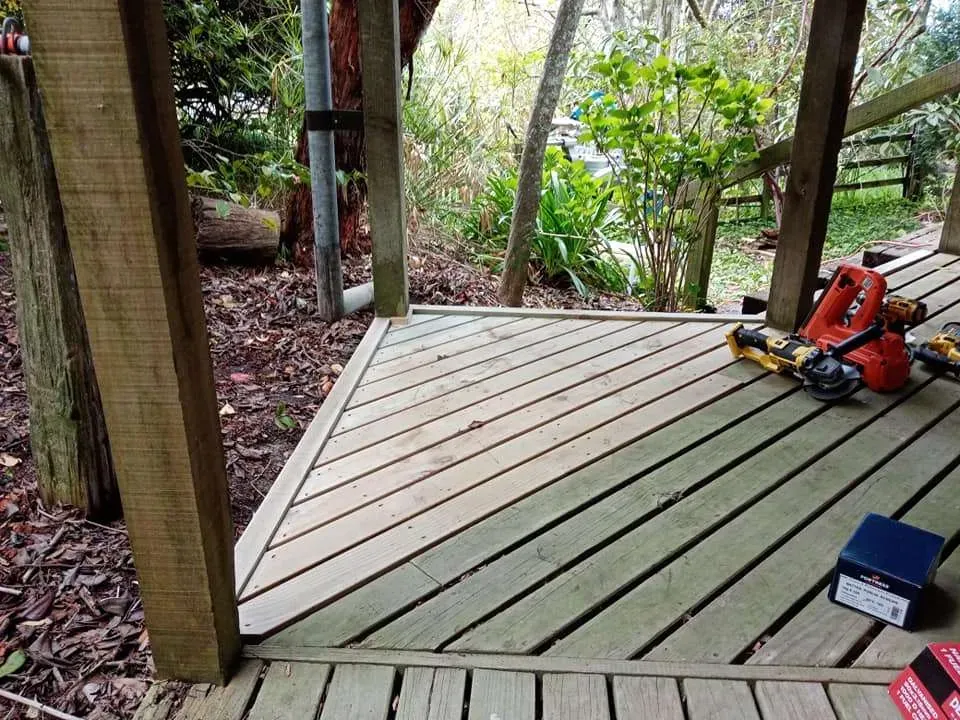
Whether a deck needs repairing or replacing comes down to the frame, not the boards. If the piles, bearers and joists are sound, you can reboard and get a deck that looks new for a fraction of a rebuild. If the frame has gone, new boards on top of it are money thrown away.
Every spring someone looks at their deck, decides it has had it, and starts pricing a new one. Often they do not need one.
The question that actually decides it
Forget the boards for a minute. The thing that decides repair or replace is the frame underneath: the piles in the ground, the bearers sitting on them, and the joists the boards are screwed to.
- Frame sound, boards tired → reboard. You get what is effectively a new deck for a lot less.
- Frame gone → replace. New boards on a failing frame is money you will spend twice.
That is the whole decision. Everything else is detail.
It is worth knowing this before you get anyone out, because a deck that looks awful from the house can be perfectly sound underneath, and one that looks fine can be held up by posts that have rotted off at ground level.
How to check it yourself in ten minutes
You need a screwdriver and somewhere to kneel.
- Get underneath, or as close as you can. If there is no access, check the exposed edges and the posts.
- Push the screwdriver into the timber at the points that stay wet. Posts at ground level, joist ends where they meet the house, anywhere water pools or soil has built up against the wood.
- Sound timber resists. If the blade sinks in with light pressure, or the timber is spongy and crumbles away, that piece has gone.
- Check several places. Rot is local before it is general. One soft post is a repair. Soft posts all along one side is a different conversation.
- Look at where the deck meets the house. This is the spot that causes the expensive problems, because water getting in there is getting into the building, not just the deck.
If everything you prod feels solid, your deck is very likely a reboarding job.
What is fixable without starting again
Plenty, as it turns out:
- Soft, split or cupped boards can be swapped individually or the whole surface relaid
- Bounce is often extra support underneath rather than a rebuild
- A sagging section is usually one failed pile or bearer
- Loose or popped fixings can be replaced, and it is worth doing before boards start moving
- Grey, furry timber is almost always cosmetic. A clean and a re-oil brings it back
- Steps at an awkward height can be rebuilt on their own
- A missing or wobbly handrail is its own small job
What means replacement
I would be straight with you about these rather than patch over them:
- Piles that have rotted at ground level, in more than one or two places
- Bearers or joists that are soft along their length rather than at the ends
- A frame built from timber that was never treated for ground contact
- Framing that has moved enough to pull the deck out of level
- A deck attached to the house in a way that is letting water into the cladding
The last one is the one to act on quickly. A failing deck is an outdoor problem. Water tracking into the building behind it is not.
Why decks fail early
Nearly always one of three things, and all three are avoidable:
Water that cannot get away. Boards laid too tight, blocked gaps, or soil and leaf litter built up against the frame. Timber that stays wet rots, treated or not.
The wrong treatment level. Timber in or near the ground needs a higher treatment level than timber in the air. Get that wrong and the posts go first while everything above them looks fine.
A bare surface. Oil and stain are not just about looks. They slow how fast the timber takes on and loses water, which is what causes cupping and splitting. A deck that has never been coated ages a lot faster than one that gets done every year or two.
That last one is the cheapest maintenance there is, and it is the one most people skip. The same logic applies to fences, which fail in exactly the same way and for the same reasons.
What I would do on a first visit
Look underneath before anything else. Prod the frame in the places that matter, check how the deck meets the house, check the fall and how water leaves it, and look at the fixings.
Then tell you which of the two jobs it is. If it is reboarding, I will say so, because that is a smaller job than a rebuild and you should know that before you budget for the bigger one.
If you want it looked at, get in touch for a free quote and I will come and have a proper look under it. I cover Nelson, Richmond, Motueka, Māpua and the wider Tasman district.
Worth reading next: Nine jobs worth doing before winter in Tasman, which covers sealing exposed timber before the weather gets into it.